I've been doing my own little book study of Teaching with Intention by Debbie Miller.
 Whoo Hoo! This is the last "real" chapter. I thought there was one more chapter, but it's just really a page of wrap-up. So this will be it for me.
Chapter 8 is called The Thoughtful Use of Time. Doesn't that just crack you up? If not, maybe this Calvin and Hobbes cartoon will. {I'm just cruising for the copyright cops to come!}

Debbie Miller acknowledges the tension we teachers are dealing with. But she says, "when getting done takes precedence over doing, when finishing becomes more important than figuring out, we've lost sight of why we became teachers in the first place..." And then she adds, "Learning by doing takes time." Can I get an Amen!
The first part of this chapter talks about time - and then she moves on to conferring with students. She admits that when she is conferring with one student, she could have been touching base with 3 or 4 or 5 or even 6 students. But, she says, "touching base isn't teaching." She tells us when conferring with students, we "support children as they apply what we've taught them in large and small group settings."
Debbie Miller asks us to try this - to confer with one or two children a day for two weeks. {Doable, isn't it?} And ask this simple question, "How's your reading going today?" If they say good, ask them to tell you more.
This is something I can see myself doing! I like this idea! What about you - are you a teacher nerd like me? Are you already, maybe just in the back of your mind, thinking about what you want to try next year?
I almost feel like having a pajama day today, but we're getting family pictures taken tonight, and I'm not sure that's the way I want to be remembered :) Maybe I'll just have a pajama morning.
Thanks for sharing Debbie Miller and Teaching with Intention with me!
Sara
Moving close to the end of my own little book study on Teaching with Intention!
Chapter 7 is Assessment, Reflections, and Next Steps.
Oh, I LOVE Calvin and Hobbes {and I'm probably breaking some copyright laws, but whatever!}
When I think of assessments, I usually think of a test that shows "did they get it?" But Debbie Miller seems to be more interested in on-going, formative assessments. She talks about conferring, observing, listening in, looking at student work, and more. She says "When we ask students to make their thinking visible during the process of learning something new, these authentic responses are the kinds of formative assessments that guide our instruction."
Did you get the last part - guide our instruction. To me, what Miller is saying is that even though I have lesson plans for the week, I need to see where my kids are as we progress, so that I can see where I need to go next.
Miller calls this Next Steps. She doesn't talk much about Next Steps, but she does say that we need to be reflective and ask ourselves questions about our lessons, and then think about what's next.
Not as much to take in as the last chapter, but more thinking for sure.
Yesterday was not the best day - my daughter ended up not feeling well all afternoon and evening. Hoping that today is better. And we have rain - that's a big Hallelujah in this dry area. Hope you have something that brings a smile to your face. Sara
Chapter 6 of Teaching with Intention - what a doozy!
Do you ever read something and just go - gulp?
That's what I'm doing here.
Chapter 6 is titled Lesson Design: Creating Lessons Based on Principles and Practices You Believe In.
Debbie Miller says, "Back then I was used to marching through teacher's guides and textbooks from beginning to end, start to finish. Children and I flitted from one topic to another - it was like we studied everything and nothing. But this new way of thinking about teaching and learning was dramatically different."
There's a gulp.
I'm guilty of that. {But in my defense, my district sets the curriculum, particularly in reading, and we are expected to follow it.}
So if I'm guilty of that, how can I stay true to my district's curriculum/guidelines, and still do some of the things that Debbie talks about? She answers that by saying, "When we're thoughtful in our planning, we lend purpose, focus, and direction to our teaching."
I feel like this is my next step - that I need to become more thoughtful in my planning. How can I tie things together? How can I help my students make connections? How can I help them see themselves as learners, readers, mathematicians? How can I show them that what we learned last week matters this week and next week and so on? How can I help them do these things themselves?
Ack - almost too much to think about. I need to store this away until later, when I start planning next year. I already have a couple ideas brewing in my mind.
Now I'm busy thinking about my summer day. Some work around the house stuff - I'm working on our back room which has basically become a dumping grounding for all our extra stuff - and then a relaxing afternoon. Hope you enjoy your day!
Sara
I know in my last blog post - my Summer Bucket List - I said I didn't want to do any school related stuff until July 15. But I feel like this is an incomplete, and I want to finish it up.
I started my own little study of
And I had gotten through chapter 4. I've got 5 chapters left, and I'm going to try to do one a day this week, just to finish this up. {And get that incomplete off my record!}
Chapter 5 is called Swimming with Sharks: Teaching for Understanding and Engagement. In this chapter, Debbie Miller takes an actual lesson, actually a unit, on sharks, and tells her readers things she does to encourage understanding. Miller says, "The point is to know who you are and what you're about when you're teaching based on your beliefs, your students, and the environment you are creating." When doing a unit of study, Miller suggests making a large file folder and labeling sections of it Our Schema, New Learning and Misconceptions.
Sort of like this from Deanna Jump:
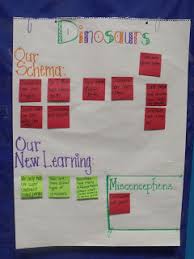
I did something similar to this with a couple units I did at the end of the year on Dinosaurs and Insects.
Wait, wait, wait - yes! {fist pump} I remembered to take pictures:
One thing I didn't do, that Debbie Miller suggests and I want to incorporate next time, is see if you "can make connections between new learning and what we already know."
Another idea Debbie Miller suggests is that when you hear your little voice in your head say Wow!, you need to "slow down, listen carefully, and think about what you just read." I try to do this with my kids, but sometimes I hear the tick, tock of the clock, and I don't take time to help them see important things we've read.
Last Saturday, Tammy from Forever in First wrote about what she values. I like what she wrote, and it encourages me to continue thinking about this. Take a look for her ideas.
Otherwise, I'm enjoying my summer break. Last week was vacation time in the Colorado Rockies - I'll have to do a show and tell soon.
Sara
Yes,
I've read the next chapter in my personal book study "Teaching with
Intention." Just didn't follow through with my intentions to post about
it last week. {ha, ha, ha, I'm so funny :)} I have computer issues - my teenager limits how much I can use it.
Have
you ever had kids do highlighting on something? Did you ever say
something like - Don't highlight everything or nothing will be
important? That's how I feel about Chapter 4, Creating Classroom
Cultures that Support and Prompt Student Thinking. I felt like I was
trying to highlight everything! I kept tell myself to focus on the
really important stuff.
Then
I started a post - and boy, it sounded blah! But since then, my one
thought on this chapter is something Debbie Miller suggested. She says,
"I keep a notebook with me when I teach." And then she captures or
writes down, things the children say. She calls them insightful or
poignant things. She does add that this might be awkward at first.
Umm,
yeah. I tried it today. I only made it through the morning. On a little
3 x 5 notebook, I had about 3 pages of things that kids said. I didn't
just do insightful things - I did some behavior things, some encouraging
words little friends shared with each other, and so on. I am finding
that the end of the school year is the perfect time to try some things
to see if I like how they go - before I implement them next year. Does
anyone keep a notebook with them to record things that happen in their
classroom? What do you record? How does it go?
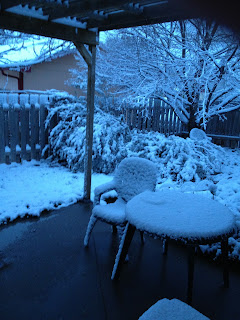
And just to keep things in perspective - this is what we woke up to this morning:
And
no, I don't live in Montana, or North Dakota. I live in SW Kansas!
Crazy! It was 80+ degrees on Monday and Tuesday - and this on Thursday.
It has already melted, of course.
This has been a good week, but I'm so looking forward to Friday. How about you?
Sara
PS - Oh wow - when I went to post this - I noticed this is my 100th post! How exciting for me :)
I'm
continuing to read Debbie Miller's book, "Teaching with Intention."
This week is about environment, or the physical space, in our rooms.

Its
hard not to think the grass is greener. When I student taught, my
mentor teacher had three huge built in cabinets, and a long row of
bookshelves, also built in. My current school doesn't have that - and
I've just got to make it work :) {As a former co-worker liked to say, "It is what it is." Too true.}
Miller gives an idea - "Step
outside your classroom door and look back in, as if for the first time.
What do you see? Do you want to go back inside?"
Ack! I say. I can think
of pictures I've taken of my kids, and yuck, there in the background is
a brown box, or a stack of books, or.... You name it.
But,
tomorrow, I plan to take this step. I'm going to go in my room tomorrow
morning, put up my coat and bag, and step back out of my room and back
in. What catches my eye - in a good way or a bad way? And for me, some photos might help me as I think through this summer how I want my space to be.
I'm also thinking of really being brave and asking a couple of my sweet students what they think about our room.
This is an awful time for me to be reading about physical space. I have WAY too many things that I just haven't taken the time to put back after I've used them. Or that need to leave my room :) But I've also been able to find a few pockets of time lately to do a little something - for example, my closet - the part that looks straight at me when I open the door.
Anyway, wondering about you - when you really take time to look and see - what do you see? Do you want to go back in? Do you care to share??
Tomorrow's Friday and I'm testing. Hoping to get it all done! Have a good one - Sara
I'm continuing my personal study of Debbie Miller's book Teaching with Intention. I looked at chapter 2 this week. {If you are interested in my take on Chapter 1, go here.}
This chapter
starts out by talking about a specific classroom as an example, and
Debbie Miller says this teacher had a vision of what she wanted for her
kids, "and she made conscious decisions and taken deliberate actions to
get them there."
Miller then talks about how she came to define
her own beliefs and she says she wishes this for us, the reader also.
She asks to ask ourselves, "what do I value?"
Miller suggests that taking time to do some writing about our practices
helps us figure out what we value. I did some of this when I first
started skimming this book, but I feel I need to continue this practice.
I think it is very easy to feel tired at the end of the day, and
writing about what's gone on just seems like another huge task. I certainly feel this way today. But I also know I enjoy writing and I
really enjoy looking back over what I've written. And I want to be a reflective teacher.
So, I'm asking you, like Debbie Miller asks in her book, what do you value in your classroom?
I have soooo many books that I want to read. They clutter the floor beside my bed. And I have a bookshelf in the empty bedroom in our basement that is starting to overflow.
So... I decide to take Monday evenings and do some actual reading. I started with this:
I had already read the first chapter and skimmed through most of the rest of it, but I've got my own copy now, so I went in with yellow highlighter - wowza! {I was also looking on my nightstand for a pencil but couldn't find one. I was thinking of really going crazy, and writing notes in the margins. What next!}
The first part is called Defining Beliefs and Aligning Practices. The first chapter is called Picture Perfect: How Does Your Ideal Classroom Look, Sound and Feel? And I highlighted the very first sentence: "If I were to ask you to close your eyes and envision the perfect classroom scene, what would you see? What would you hear and smell and feel?"
And then, Debbie Miller says, "Once you take the time to envision exactly what it is you want for you and the children you teach, you can set about taking action and bringing your vision to life."
Personally, I think this is the perfect time to start thinking about this. It's getting close to the end of the year. I can think about things I think aren't working, and what is working {yes, please Sara, do this! (because I seem to be a pessimist)} And what do I want to do differently.
I need to make notes. I need to think about what's important to me. Like, I want my class to be enjoyable. I want, for the most part, for my classroom to be somewhere my kids want to be.
So, what else do I want? I also want to plan more fun, memorable ideas. I often feel that our time together is so structure, that my students and I don't have much time to do some of the creative things I'd like to try. But maybe I need to do a better job in planning those times.
Just this tip of the iceberg has gotten me thinking. What about you, what would your perfect classroom look like? This is like my own personal book study, but I'd love to hear from you, if you have a thought or idea to add.
Thanks, Sara
I am such a teacher nerd. These came yesterday:
And boy was I excited!
{This comes one day after telling my sister I've got too many books in my back room. Hmmm. Wonder how that happens, don't you?}
I had started reading my school's copy of Teaching with Intention and decided I needed my own so I can mark in it. It may be difficult to apply some of this because we have a basal series and our district has a certain way they want to teach that - what on what days and even what story what week. But I want to continue to be a better teacher :)
Reading with Meaning - well, maybe same caveats as above - but I really want my little buggers to not only learn to read, but enjoy it. How many of us have stayed up too late reading an engrossing novel? Or want to finish looking at the magazine we just got in the mail? Or look at one more blog post?? (OK, maybe the last one is the one that got you!)
I am holding off - I'm on my last day of Spring Break - so I'm trying to stay away from school things. I think I need a study night. I have so many books I really want to read, but don't seem to have time, or make time for them.
So what's the most exciting thing that's happened to you over Spring Break?


